
Unlocking the Potential of Solar Energy for Farms and Businesses
As electricity costs continue to fluctuate across Ireland, farms and businesses are looking for practical ways to reduce energy costs, improve energy independence and take greater control of their electricity usage.
Solar photovoltaic (PV) technology offers an opportunity to generate electricity on-site from daylight, helping agricultural and commercial customers reduce their reliance on electricity purchased from the national grid.
For a modern farm, solar can help power milking parlours, refrigeration, water pumps, ventilation and workshops. For businesses, it can help support offices, warehouses, retail premises, manufacturing facilities, hotels and other energy-intensive operations.
Solar PV is no longer simply an environmental choice. When properly designed around your electricity consumption, it can be a long-term investment designed to reduce operating costs and make better use of your available roof or ground space.
At North Cork Electrical, we design and install tailored solar PV systems for agricultural and commercial customers throughout Ireland, with each system designed around the property’s energy requirements, operating patterns and future energy needs.
What Is Solar PV and How Does It Work?
Solar photovoltaic (PV) panels generate electricity from daylight using photovoltaic cells.
When daylight reaches the solar panels, they generate Direct Current (DC) electricity.
However, the electrical equipment used by farms and businesses operates using Alternating Current (AC) electricity.
This is where the solar inverter comes in.
The inverter converts the DC electricity generated by the solar panels into AC electricity that can be safely used by your property’s electrical systems.
This allows solar-generated electricity to power everything from lighting and office equipment to refrigeration, machinery, pumps, ventilation systems and agricultural equipment.
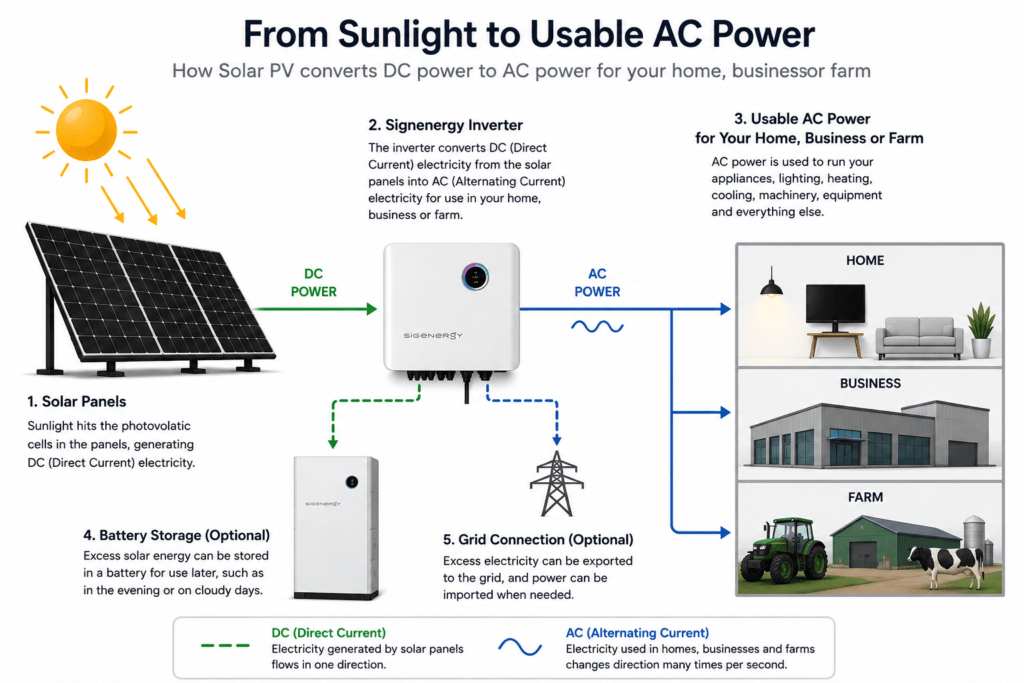
If your solar panels generate more electricity than your business or farm is using at that moment, the surplus electricity can potentially be:
- Stored in a battery for use later
- Used to supply other electrical loads on-site
- Exported to the electricity grid where applicable
- Used to reduce the amount of electricity purchased from your electricity supplier
The objective is simple: generate electricity where you need it and make as much use of that electricity on-site as possible.
Understanding DC and AC Electricity
One of the most important parts of understanding a solar PV system is knowing the difference between DC and AC electricity.
Solar panels generate DC electricity, while the electrical equipment throughout a farm or commercial premises generally operates on AC electricity.
The inverter provides the connection between the two.
What Is DC (Direct Current)?
Direct Current (DC) electricity flows continuously in one direction.
Solar panels naturally generate DC electricity when exposed to daylight.
This electricity is produced by the photovoltaic cells within the panels, but it cannot normally be used directly by the majority of electrical equipment found in agricultural and commercial premises.
What Is AC (Alternating Current)?
Alternating Current (AC) electricity changes direction many times every second.
This is the type of electricity supplied by the national grid and used by most electrical equipment.
On a farm, this can include:
- Milking parlours
- Refrigeration systems
- Water pumps
- Ventilation
- Lighting
- Workshop equipment
- Feed systems
- Grain drying equipment
In commercial environments, AC electricity powers equipment such as:
- Machinery
- Refrigeration
- HVAC systems
- Lighting
- Computers and office equipment
- Production equipment
- Pumps and motors
- Warehouse systems
Why Is the Inverter So Important?
The inverter acts as the bridge between your solar panels and your electrical system.
It converts the DC electricity generated by the panels into AC electricity that your farm or business can use.
Without the inverter, the electricity generated by the solar panels could not be used by the vast majority of your existing electrical equipment.
A correctly specified inverter is therefore a critical part of designing an efficient and reliable solar PV system.
Agricultural Solar PV
Modern agriculture relies heavily on electricity.
From milking and refrigeration to water pumping, ventilation, grain drying and workshop equipment, electricity is an essential part of day-to-day farm operations.
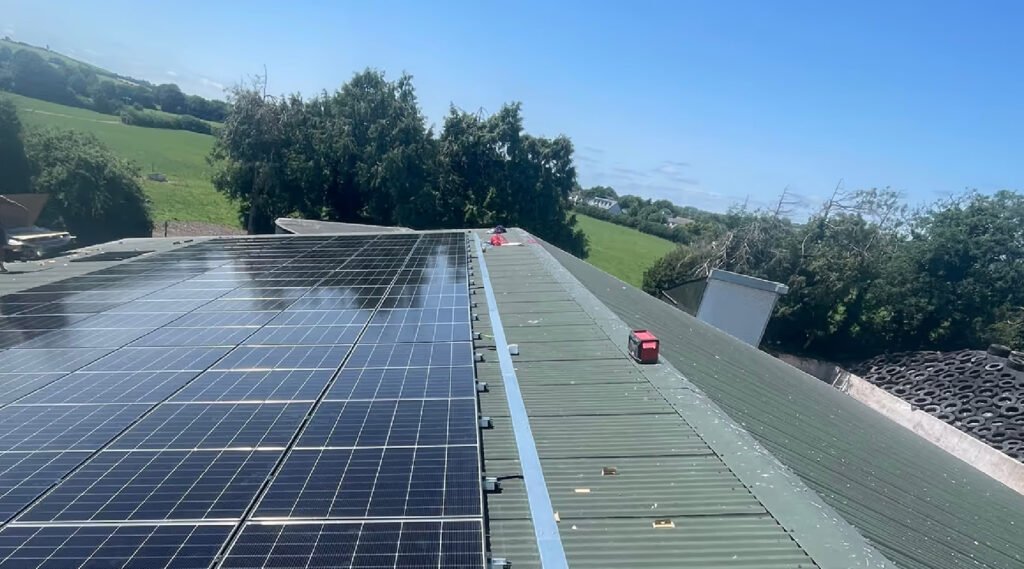
For farms with suitable buildings, large roofs can provide valuable space for solar PV, allowing electricity to be generated directly where it is being consumed.
Ground-mounted systems can also provide another option where suitable land is available and a roof-mounted system isn’t the most appropriate solution.
Where Can Solar Help on a Farm?
Solar PV can help generate electricity for a wide range of agricultural applications, including:
- Milking parlours
- Milk cooling and refrigeration
- Water pumps
- Ventilation systems
- Grain drying
- Farm workshops
- Lighting
- Feed systems
- Cold storage
- Agricultural machinery and equipment
The biggest opportunity comes from matching solar generation with the farm’s electricity consumption.
For farms that use significant amounts of electricity during daylight hours, generating power on-site can help reduce the amount of electricity that needs to be purchased from the grid.
Benefits of Agricultural Solar PV
A properly designed agricultural solar PV system can help:
- Reduce electricity costs
- Reduce reliance on the electricity grid
- Improve long-term energy planning
- Make productive use of available roof or ground space
- Increase on-site renewable energy generation
- Reduce carbon emissions
- Support long-term farm sustainability
- Prepare the farm for future electrical demand
Every farm is different.
Electricity consumption, building orientation, available roof space, existing electrical infrastructure and future expansion all need to be considered when designing a system.
Commercial Solar PV
For many businesses, electricity is a significant ongoing operating expense.
Commercial premises can often be particularly well suited to solar PV because electricity demand frequently occurs during daylight hours, when solar panels are generating electricity.
Instead of purchasing all of your electricity from the grid, a commercial solar PV system allows your business to generate a portion of its electricity on-site.
This can help reduce grid electricity consumption and potentially lower ongoing operating costs.
Suitable for a Wide Range of Businesses
Solar PV can be designed for many different commercial environments, including:
- Offices
- Retail premises
- Warehouses
- Manufacturing facilities
- Industrial buildings
- Hotels
- Workshops
- Agricultural businesses
- Food production facilities
- Distribution centres
- Commercial units
Benefits of Commercial Solar PV
A commercial solar PV system can help businesses:
- Reduce electricity bills
- Lower operating costs
- Generate electricity on-site
- Reduce reliance on grid electricity
- Improve energy efficiency
- Increase energy independence
- Support sustainability objectives
- Reduce carbon emissions
- Prepare for future increases in electricity demand
For businesses with high daytime electricity consumption, solar can be particularly valuable because electricity is being generated at the same time the business is operating.
Solar PV and Energy-Intensive Operations
Not all electricity usage is the same.
A business operating machinery throughout the day will have a very different energy profile from an office operating mainly during standard working hours.
Likewise, a dairy farm may have significant electricity demand from milking, refrigeration and water pumping at different times throughout the day.
This is why simply choosing the largest possible solar system isn’t always the best approach.
A well-designed system considers how much electricity you use, when you use it and how much solar electricity can realistically be consumed on-site.
Understanding your energy usage allows the system to be designed around your actual operation rather than simply the available roof space.
Battery Storage: Making More of Your Solar Energy
Solar panels generate electricity during daylight hours, but farms and businesses don’t necessarily use all of their electricity at the exact moment it is generated.
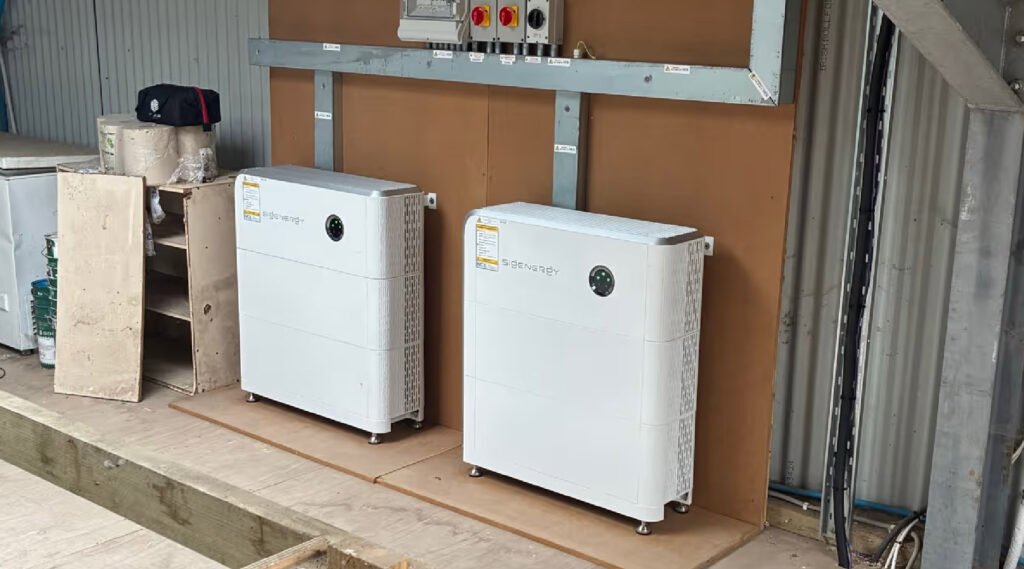
Battery storage provides a way of storing surplus solar electricity for later use.
For example, electricity generated during the day could be stored in a battery and then used later when solar generation decreases.
This can increase the amount of solar electricity consumed on-site and reduce the amount of electricity imported from the grid.
Benefits of Battery Storage
Depending on the system design, battery storage can provide:
- Higher self-consumption of solar energy
- Reduced electricity imports from the grid
- Greater energy independence
- More flexibility in how electricity is used
- Potential backup power capability
- Greater control over your energy usage
Battery storage can be particularly useful for businesses and farms where electricity demand continues outside peak solar generation hours.
Solar PV Grants for Agriculture and Business
Government support can help make solar PV more accessible for eligible agricultural and commercial customers.
SEAI schemes and grant eligibility can change, and different requirements may apply depending on the type of property, business and installation.
Before investing, it is important to check the current eligibility criteria, grant amounts and application requirements.
North Cork Electrical can help customers understand the solar installation process and identify the information required when considering a solar PV project.
Designing Solar Around Your Business or Farm
There is no single solar system that works for every farm or business.
A professional solar PV design should consider factors including:
- Current electricity consumption
- Daytime and nighttime electricity usage
- Available roof space
- Roof orientation and condition
- Ground-mounted options where appropriate
- Existing electrical infrastructure
- Solar panel capacity
- Inverter specification
- Battery storage requirements
- Future expansion
- Potential electricity export
The aim is to create a system that works with your operation, rather than forcing your operation to work around the solar system.
Why Choose North Cork Electrical?
Every farm and business has different energy requirements.
At North Cork Electrical, we take a tailored approach to solar PV, designing systems around how your property actually uses electricity.
We provide:
- Tailored energy assessments
- Custom-designed solar PV systems
- Agricultural and commercial installations
- Roof-mounted and ground-mounted solar solutions
- Battery storage solutions
- Professional installation by experienced electricians
- System monitoring through our NCE Power Portal
- Ongoing technical support and aftercare
From agricultural buildings and farmyards to commercial premises and industrial facilities, our goal is to help customers make better use of their own energy generation.
Invest in Your Energy Future
Solar PV gives farms and businesses the opportunity to generate their own electricity from daylight and reduce their dependence on electricity purchased from the grid.
The process starts with the solar panels generating DC electricity.
The inverter then converts that DC electricity into AC electricity, allowing it to power the electrical equipment already operating throughout your farm or business.
Any suitable surplus can potentially be stored in battery storage or exported to the grid, depending on the system and applicable arrangements.
With the right design, solar PV can become an important part of your long-term energy strategy, helping reduce electricity costs, improve energy independence and support a more sustainable operation.
From farm to factory, solar can put your available roof or ground space to work.
Contact North Cork Electrical to discuss your agricultural or commercial solar PV requirements and discover how a system can be designed around your energy usage.